Blog Details
19
Jan
6 IT Service Trends for 2026: Navigating the Year of Truth and Agentic AI
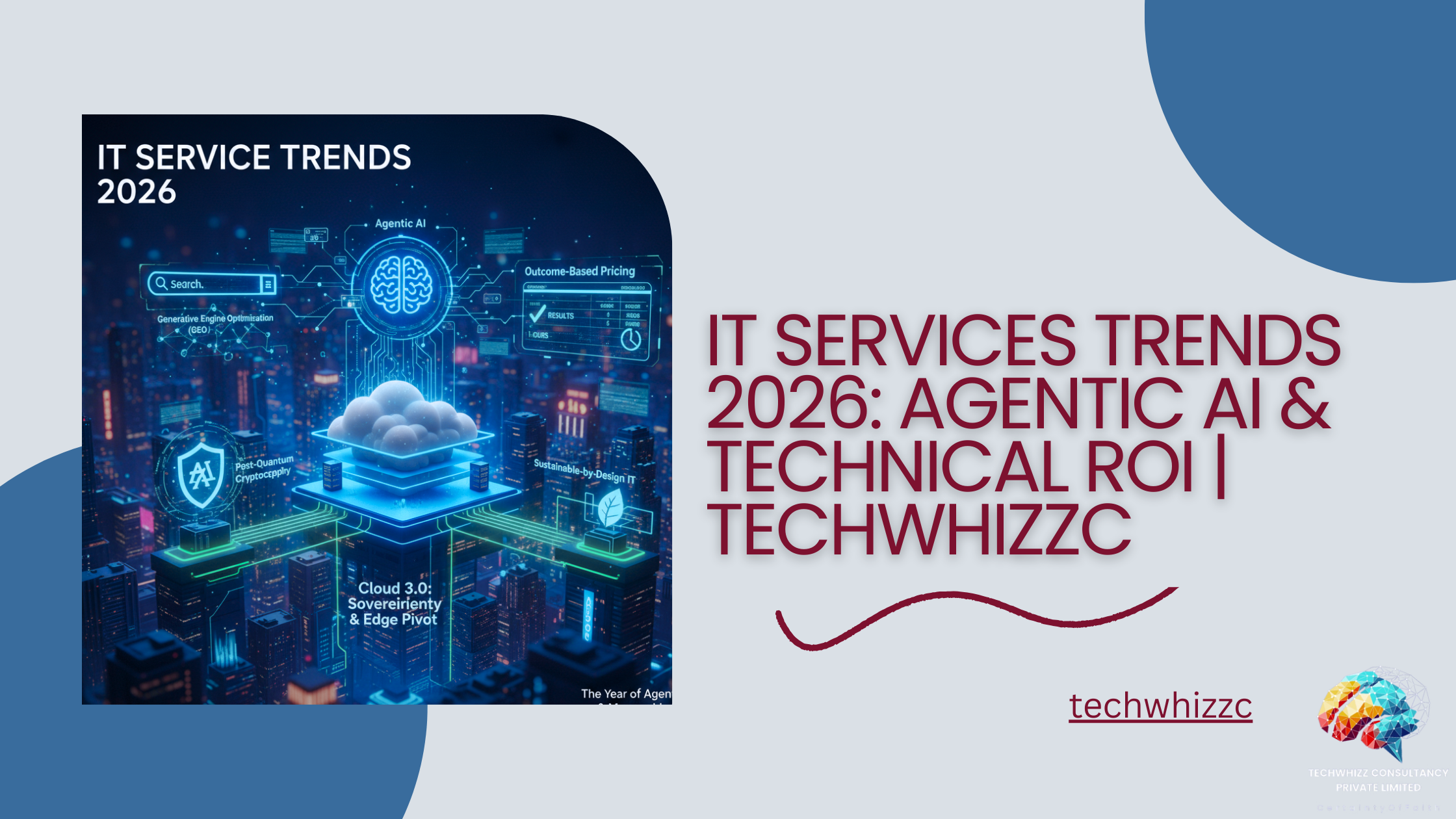
The Shift to Agentic AI: Building a Digital Workforce
The defining update of 2026 is the move from "Chatbots" to Agentic AI. While 2024 was about AI that answers questions, 2026 is about AI that executes goals.
Autonomous Action: Today’s systems don't just wait for a prompt; they monitor business conditions (like stock levels or server health) and take action automatically.
The Orchestration Layer: Modern IT services now focus on AgenticOps—the practice of managing multiple AI agents that collaborate to solve end-to-end business problems.
Informational Note: Success in this era requires a specialized IT consultancy to ensure these "silicon workforces" follow strict governance and don't create unintended operational loops.
Cloud 3.0 and the Sovereign Priority
The "one-size-fits-all" public cloud model is a thing of the past. In 2026, Cloud 3.0 has introduced a hybrid architecture that balances global scale with local control.
Sovereign Clouds: These are highly secure, regionalized cloud environments designed to keep sensitive data within specific legal borders.
Edge Intelligence: To support real-time AI, data processing has moved to the "Edge"—physically closer to the user to eliminate latency.
Practical Impact: For many organizations, the shift involves migrating from bloated, centralized systems to leaner, more agile local infrastructures, a transition often facilitated by a nearby IT consultancy and solution expert.
The Arrival of Outcome-Based IT Pricing
The traditional "billable hour" has largely vanished. In a world where an AI agent can perform hours of human labor in seconds, charging for time no longer makes sense for either party.
Measuring Impact: Modern service agreements are now tied to KPIs—uptime, security benchmarks, or specific revenue growth.
Technical ROI: This model forces IT providers to prioritize efficiency. You aren't just paying for maintenance; you are investing in a partnership where the provider's success is tied directly to your own.
Post-Quantum Cryptography (PQC) Readiness
Security in 2026 is dominated by the threat of "Harvest Now, Decrypt Later." Hackers are currently stealing encrypted data with the intent to unlock it once quantum computers become widely available.
Quantum-Ready Audits: Leading IT firms are now implementing Post-Quantum Cryptography (PQC). These are mathematical "locks" that are resistant even to quantum-level processing.
Proactive Defense: Waiting for a breach is no longer an option. Future-proofing your data vault today is the only way to maintain customer trust over the next decade.
Generative Engine Optimization (GEO): The New SEO
If your business doesn't appear in a ChatGPT or Gemini response, you effectively don't exist to the modern consumer.
Search for AI Eyes: GEO is the process of structuring your digital footprint so that AI "Agents" recommend your brand.
Entity Clarity: This requires more than just keywords. It involves creating a high-authority, schema-rich backend. When an AI agent asks, "Who is a reliable nearby digital marketing company?", your data must be structured to provide the clear, authoritative answer.
Sustainable-by-Design Infrastructure
In 2026, "Green IT" is a budget line item. High-performance AI is energy-intensive, leading to new regulations around carbon footprints in the tech sector.
Energy-Aware Coding: Software is now being optimized to use less battery and less server power.
Operational Savings: Sustainable tech isn't just for the planet—it's for the bottom line. Reducing energy consumption directly lowers your cloud and hardware overhead.
Conclusion
The common thread through all these trends is the need for Technical ROI. Whether it’s optimizing your infrastructure for the latest AI agents or securing your data against future threats, the modern founder needs a partner who understands the "why" as much as the "how."
Is your infrastructure ready for the Year of Truth? Exploring the Startup Growth Blueprints at TechWhizzc can help you identify exactly which technologies will provide the most value for your specific vision
_(1920_x_1080_px).png)
.png)
.png)

.png)